Role of AI in Academic Writing – Write Smarter, Research Faster, and Achieve More
Published: 16 Nov 2026
In today’s academic world, artificial intelligence is becoming an indispensable tool for students, researchers, and educators. AI is transforming the way academic papers, theses, and research articles are written, reviewed, and refined.
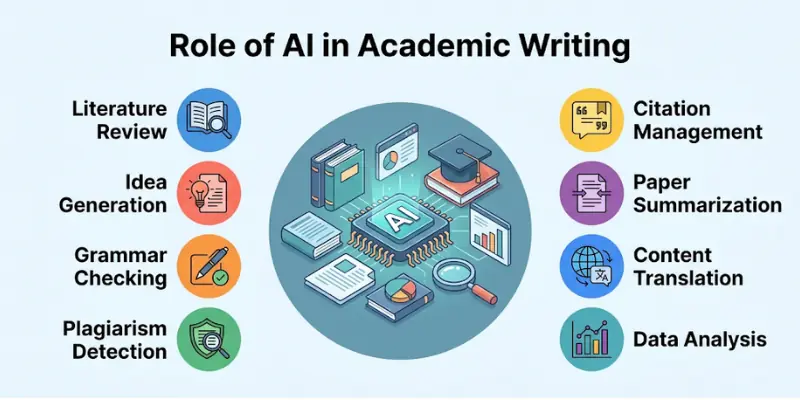
In simple terms, AI in academic writing refers to intelligent systems that assist in drafting content, generating ideas, checking grammar, detecting plagiarism, formatting references, and summarizing research. These systems aim to enhance productivity, improve quality, and save time for writers.
In this guide, I’ll explain the role of AI in academic writing, highlighting its key applications, benefits, and future potential. We’ll cover ten major roles that show how AI is revolutionizing research and scholarly writing.
Mostly, our focus will be on understanding how AI supports writers in creating accurate, coherent, and high quality academic content efficiently.
Participation of AI in Academic Writing
AI supports academic writers by improving research efficiency, content quality, and overall productivity. It helps scholars manage data, generate ideas, and adhere to academic standards while reducing repetitive tasks.
Here are the top 10 roles AI plays in academic writing:
- Research and Literature Review Assistance
- Content Generation and Idea Suggestions
- Grammar and Style Checking
- Plagiarism Detection and Prevention
- Reference and Citation Management
- Summarizing Academic Papers
- Translating Research Content
- Data Analysis and Visualization Support
- Writing Feedback and Improvement Suggestions
- Enhancing Productivity and Workflow
Let us cover all in detail.
1. Research and Literature Review Assistance
AI helps researchers find relevant sources, journals, and articles efficiently. It can scan thousands of papers and summarize key findings in seconds, saving hours of manual search.
How It Works: AI powered academic search engines analyze keywords, topics, and citation patterns to deliver relevant literature.
Benefits:
- Speeds up the research process
- Provides comprehensive coverage of topics
- Reduces manual effort
- Supports informed writing decisions
Ultimately, these research capabilities help writers find valuable evidence faster and build stronger academic foundations.
2. Content Generation and Idea Suggestions
AI assists in generating initial drafts, outlines, or research ideas for academic writing. It helps writers overcome writer’s block and structure papers effectively.
How It Works: AI models generate text based on prompts, research data, or previous writing patterns.
Benefits:
- Speeds up drafting process
- Provides creative suggestions for topics
- Helps structure complex arguments
- Enhances brainstorming efficiency
As a result, AI generated suggestions make it easier to overcome writer’s block, organize thoughts, and begin writing with confidence.
3. Grammar and Style Checking
AI ensures academic papers are free from grammatical errors and adhere to style guidelines. It checks sentence structure, punctuation, and readability for professional quality writing.
How It Works: AI tools analyze text and suggest corrections or improvements according to academic writing standards.
Benefits:
- Improves clarity and professionalism
- Reduces editing time
- Enhances overall readability
- Supports consistent style adherence
Overall, these improvements help researchers produce clearer, more polished, and professionally presented academic papers.
4. Plagiarism Detection and Prevention
AI detects similarities between submitted work and published sources, preventing plagiarism. It helps maintain academic integrity by highlighting potential issues before submission.
How It Works: AI compares text against vast databases of published research and student papers.
Benefits:
- Ensures originality of work
- Helps writers properly cite sources
- Reduces risk of academic misconduct
- Promotes ethical writing practices
In this way, plagiarism detection tools encourage originality, responsible referencing, and stronger academic integrity.
5. Reference and Citation Management
AI assists in formatting references according to specific citation styles (APA, MLA, Chicago, etc.). It ensures that citations are accurate and consistent throughout the paper.
How It Works: AI tools organize bibliographic data and automatically generate citations.
Benefits:
- Saves time in reference management
- Reduces formatting errors
- Ensures consistency across papers
- Supports academic compliance
These features make citation management easier, helping writers maintain accurate references and consistent academic formatting.
6. Summarizing Academic Papers
AI can summarize lengthy research papers, reports, or articles into concise points. It helps writers quickly grasp the key findings and integrate them into their work.
How It Works: AI algorithms extract essential information, generating summaries without losing meaning.
Benefits:
- Saves time during literature reviews
- Supports efficient knowledge synthesis
- Improves understanding of complex papers
- Enables quicker integration of sources
Ultimately, concise summaries help researchers understand complex studies quickly and use relevant findings more effectively.
7. Translating Research Content
AI helps translate academic content into multiple languages for wider accessibility. It ensures clarity and preserves technical meaning in translations.
How It Works: AI translation tools use natural language processing to convert text while maintaining context and tone.
Benefits:
- Expands global reach of research
- Facilitates collaboration across languages
- Reduces translation errors
- Supports multilingual academic writing
This makes academic knowledge more accessible across language barriers and creates greater opportunities for international research collaboration.
8. Data Analysis and Visualization Support
AI assists researchers in analyzing data and creating visualizations for academic papers. It can process large datasets, generate graphs, and detect trends efficiently.
How It Works: AI analyzes quantitative or qualitative data and produces visual representations or insights.
Benefits:
- Supports data driven writing
- Enhances presentation of results
- Reduces manual analysis workload
- Improves accuracy of conclusions
Together, these capabilities help researchers present meaningful findings clearly and support their arguments with data driven evidence.
9. Writing Feedback and Improvement Suggestions
AI provides feedback on clarity, structure, and argumentation in academic writing. It helps writers refine their papers before submission.
How It Works: AI tools evaluate coherence, logical flow, and style, providing actionable improvement suggestions.
Benefits:
- Enhances quality of writing
- Identifies weak arguments or inconsistencies
- Supports iterative improvement
- Boosts confidence in academic work
With continuous feedback, writers can refine their arguments, strengthen their structure, and improve the overall quality of their academic work.
10. Enhancing Productivity and Workflow
AI streamlines the entire academic writing process from research to editing and submission. It allows writers to focus on critical thinking while automating repetitive tasks.
How It Works: AI integrates multiple writing and research tools into a cohesive workflow.
Benefits:
- Saves time and effort
- Reduces cognitive load on writers
- Improves overall research efficiency
- Supports consistent high quality output
Ultimately, AI supported workflows help researchers save time on repetitive tasks and devote more attention to critical thinking and original ideas.
Future of AI in Academic Writing
The future of AI in academic writing is bright. AI will continue to enhance research efficiency, provide smarter writing assistance, detect plagiarism more accurately, and support multilingual and data driven academic work.
Writers and researchers will increasingly rely on AI to produce well structured, high quality, and impactful papers, improving knowledge dissemination worldwide.
Conclusion
In this guide, we explored the role of AI in academic writing. AI assists in research, drafting, editing, plagiarism detection, citation management, summarization, translation, and data analysis.
By integrating AI, academic writing becomes more efficient, accurate, and productive, empowering students and researchers to focus on critical thinking, creativity, and scholarly excellence.
FAQs
Want to understand how AI is changing academic writing? These frequently asked questions explore how intelligent tools support research, improve writing quality, simplify editing, and make scholarly communication more accessible.
1. How does AI help in academic writing?
AI supports different stages of academic writing, making the process more organized and efficient. It can help with:
- Finding relevant research sources.
- Generating ideas and preparing outlines.
- Improving grammar, clarity, and style.
- Summarizing papers and organizing citations.
2. Can AI generate ideas for academic papers?
Yes. AI can suggest research topics, outlines, and writing ideas based on your interests and prompts. How to use it:
- Enter your research topic or area of interest.
- Ask for relevant research questions or topic suggestions.
- Review the ideas and select a suitable direction.
- Develop your own arguments using reliable academic sources.
3. How does AI improve grammar and style?
AI writing assistants review academic text and suggest improvements to make it clearer and more professional.
| Writing area | How AI helps |
| Grammar | Identifies grammatical mistakes |
| Spelling | Highlights misspelled words |
| Punctuation | Suggests punctuation corrections |
| Style | Improves clarity and readability |
4. Can AI detect plagiarism in research papers?
Yes. AI powered plagiarism detection tools compare submitted text with available publications and databases to identify possible similarities. They help writers:
- Identify overlapping passages.
- Review quotations and paraphrased content.
- Check whether sources are properly cited.
- Maintain responsible academic writing practices.
However, similarity reports require careful interpretation and do not independently prove plagiarism.
5. How does AI help with citations and references?
AI powered citation tools simplify reference management by helping writers organize sources and format bibliographies.
- APA: Supports author date referencing.
- MLA: Helps format humanities references.
- Chicago: Supports notes and bibliography or author date styles.
Always verify citation details against the original source and the required style guidelines.
6. Can AI summarize long research papers?
Yes. AI can condense lengthy academic papers into shorter summaries that highlight their main information. It can help identify:
- Research objectives and questions.
- Methods used in the study.
- Key findings and results.
- Conclusions and limitations.
This makes literature reviews and research preparation more manageable, although important details should always be checked against the original paper.
7. Does AI support multilingual academic writing?
Yes. AI translation and language tools help researchers communicate their work across different languages. Key benefits include:
- Translating research content into multiple languages.
- Improving English grammar for non native speakers.
- Preserving technical terminology with careful review.
- Supporting international academic collaboration.
8. How does AI help with data analysis in writing?
AI supports academic data analysis by identifying patterns, exploring relationships, and helping researchers present findings visually.
| Application | Research benefit |
| Data processing | Handles large datasets |
| Pattern detection | Identifies trends and relationships |
| Charts and graphs | Presents results visually |
| Data interpretation | Supports evidence based conclusions |
9. Can AI provide feedback on writing quality?
Yes. AI writing tools can review academic papers and suggest improvements in several areas:
- Clarity: Makes sentences easier to understand.
- Coherence: Checks the logical flow of ideas.
- Structure: Highlights organizational weaknesses.
- Tone: Suggests a more appropriate academic style.
Writers should evaluate these suggestions carefully to preserve their original meaning and arguments.
10. What is the future of AI in academic writing?
The future of AI in academic writing is likely to bring more advanced research assistance, personalized editing, and accessible scholarly communication.
Some expected developments include:
- Faster literature searches and research summaries.
- More accurate writing and editing assistance.
- Improved multilingual research collaboration.
- Advanced data analysis and visualization.
- More integrated academic writing workflows.
Ultimately, AI may become an increasingly valuable research assistant, while original thinking, academic integrity, and human judgment remain essential.

The Hidden Role of AI in Personalization in 2026: Smarter Shopping, Streaming, and Ads





- Be Respectful
- Stay Relevant
- Stay Positive
- True Feedback
- Encourage Discussion
- Avoid Spamming
- No Fake News
- Don't Copy-Paste
- No Personal Attacks
- Be Respectful
- Stay Relevant
- Stay Positive
- True Feedback
- Encourage Discussion
- Avoid Spamming
- No Fake News
- Don't Copy-Paste
- No Personal Attacks
