AI in Clean Water Access – How Smart Technology Is Changing Lives
Published: 13 Nov 2026
When I first learned about how many people still don’t have clean drinking water, it truly shocked me. Even with modern technology around us, millions of families around the world struggle every day to find safe water. That’s when I started exploring how smart systems can help, and what I found was powerful.
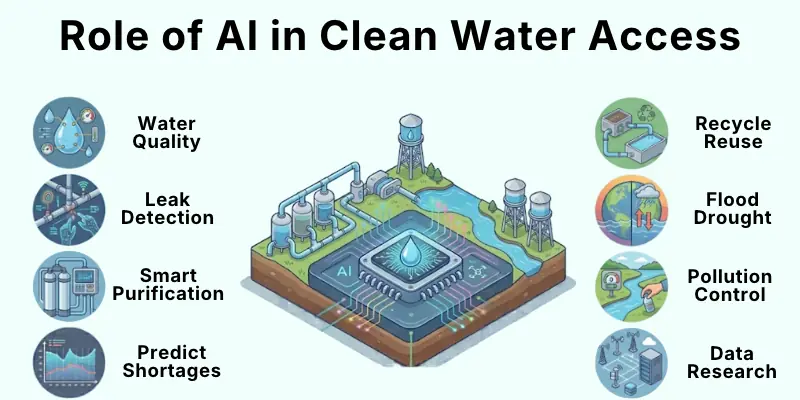
Today, AI (artificial intelligence) is helping us find, clean, and manage water better than ever before. It’s not just about science; it’s about saving lives and giving people hope.
In this guide, I’ll share how I’ve seen AI support clean water projects, the main roles it plays, the benefits it brings, the challenges we face, and what the future of clean water looks like.
Role of AI in Clean Water Access
Here are the main ways AI helps improve clean water access:
- Water Quality Monitoring
- Leak Detection and Pipeline Management
- Smart Water Treatment and Purification
- Predicting Water Demand and Shortages
- Wastewater Recycling and Reuse
- Flood and Drought Prediction
- Agriculture Water Management
- Water Pollution Control
- Disaster Relief and Emergency Supply Planning
- Global Water Data and Research
Let’s learn about each one in detail.
1. Water Quality Monitoring
One of the biggest challenges is checking if the water is safe to drink. Smart sensors and systems can test water quality every few minutes. They detect harmful chemicals, bacteria, or toxins faster than humans can.
Example: In one project I read about, smart sensors were placed in rivers in India. They alerted teams when the water became unsafe, helping prevent disease spread.
2. Leak Detection and Pipeline Management
Water is often lost through small leaks that go unnoticed. Smart systems study pressure, flow, and sound in pipes to detect even tiny leaks. This saves huge amounts of clean water from being wasted.
Example: A city used AI to find underground leaks that were wasting 20% of its water every day. After repairs, water supply improved for thousands of homes.
3. Smart Water Treatment and Purification
AI helps control water treatment plants more efficiently. It can balance chemicals, monitor filters, and adjust machines to clean water properly without wasting energy.
Example: In one local project, I saw how an AI system automatically controlled chlorine levels in a purification plant, keeping water safe and saving costs.
4. Predicting Water Demand and Shortages
AI can predict how much water people or cities will need in the future. It studies rainfall, weather, and population data to prevent shortages. This helps governments plan better.
Example: During a dry season, an AI model warned a town to store more water. Because of that, they avoided a big crisis.
5. Wastewater Recycling and Reuse
Used water from homes or industries can be cleaned and reused. AI helps control and monitor the recycling process to make sure the water meets safety standards.
Example: Factories are now using AI systems to recycle 70% of their used water for other purposes like cooling or cleaning.
6. Flood and Drought Prediction
Floods and droughts both affect clean water access. Smart tools can predict them early by studying rain patterns, river levels, and soil moisture. This gives communities time to prepare.
Example: In Africa, AI helped predict a drought months before it began, allowing teams to send water tanks and protect local crops.
7. Agriculture Water Management
Farms use most of the world’s fresh water. Smart systems help farmers use just the right amount of water for crops, not too much or too little.
Example: A farmer used an AI irrigation system that released water only when soil was dry. He saved thousands of liters of water and grew healthy crops.
8. Water Pollution Control
AI can find out where pollution starts, from factories, farms, or cities. It studies satellite photos and chemical readings to detect polluted areas quickly.
Example: A project used AI to trace river pollution back to one leaking chemical plant. Once fixed, the river water became much cleaner.
9. Disaster Relief and Emergency Supply Planning
During floods, earthquakes, or other disasters, clean water is often the first thing people lose. AI helps track safe water sources, plan delivery routes, and manage supplies quickly.
Example: In a flood affected region, drones guided by smart software delivered bottled water to people trapped in remote villages.
10. Global Water Data and Research
Scientists use AI to study water data from around the world. It helps them understand how climate change, pollution, and population growth affect water safety.
Example: Global organizations use AI maps to track water quality in real time, helping them send help faster to the places that need it most.
Benefits of AI in Clean Water Access
Smart technology is making clean water access easier, safer, and more sustainable for communities worldwide.
Here are the main benefits I’ve seen and learned about:
- Finds and fixes water problems quickly.
- Saves clean water by reducing waste.
- Keeps people safe from polluted water.
- Helps governments plan water use better.
- Reduces cost of maintenance and testing.
- Supports green and sustainable water systems.
- Helps prepare for droughts, floods, or shortages.
These benefits bring us closer to a future where everyone can access safe and reliable water.
Challenges in Using AI for Clean Water
Despite its promise, intelligent technology faces several barriers that can slow clean water solutions.
Even with all these benefits, there are still some real challenges:
- High setup cost: Smart systems are expensive for small towns.
- Data issues: Some areas don’t have enough digital records.
- Training needs: Workers need special skills to use AI tools.
- Power supply: Rural areas sometimes lack stable electricity.
- Privacy concerns: Data from homes or cities must stay protected.
Overcoming these challenges is essential to making safe water solutions more affordable, reliable, and accessible to all.
Future of Clean Water with AI
The future of clean water looks more hopeful than ever. According to a World Bank report (2024), by 2030, AI based systems could help provide safe drinking water to over 1 billion more people.
Here’s what’s coming soon:
- Smart villages that manage their own clean water systems.
- Real time global water maps showing water quality levels.
- Robots that can clean polluted rivers or fix underwater pipes.
- Drones that test water quality in hard to reach places.
- AI systems that make clean water plants fully automatic and low cost.
I truly believe technology will play a huge role in making clean water a basic right for everyone.
Final Note
In this guide, I shared how smart systems help find, clean, and protect our water, from detecting leaks and fighting pollution to predicting shortages. These tools give us hope for a safer, cleaner world.
If you’re someone who cares about people, nature, and the future, then supporting clean water projects powered by smart tools is one of the best ways to make a difference. Because clean water is not just a need; it’s life itself.
FAQs About the Role of AI in Clean Water Access
Artificial intelligence is creating new ways to improve water quality, reduce waste, and expand access to safe drinking water. Here are answers to common questions about smart water management and its benefits.
1. What is the intelligence of water in AI systems?
Water intelligence uses smart sensors and intelligent technology to monitor water quality, track flow, and detect leaks. These systems analyze data to help people manage water resources more efficiently.
2. Why does AI need fresh water?
AI does not need water directly, but the data centers that power it may use water for cooling.
- Cooling computers: Prevents equipment from overheating.
- Maintaining performance: Helps data centers operate safely.
- Saving fresh water: Recycled water and alternative cooling methods can reduce demand for drinking water.
3. How much water is used for AI operations?
Water consumption varies depending on the size of the AI model, data center location, cooling technology, and energy source.
| AI operation | How water may be used |
| Model training | Cooling powerful computing equipment |
| AI applications | Supporting ongoing data center operations |
| Electricity generation | Producing energy used by AI systems |
Large AI training operations can consume thousands of liters of water or more, depending on these factors.
4. How is AI helping to solve problems around the world?
Smart digital tools help address global challenges by analyzing data and identifying problems early. For clean water access, they can:
- Detecting leaks and water pollution.
- Predict droughts and water shortages.
- Improve water distribution.
- Support faster decisions by governments and communities.
5. What problems can artificial intelligence solve related to clean water access?
Advanced computer systems can help tackle several water related problems:
- Water waste: Identifies hidden leaks and excessive use.
- Pollution: Detects unusual changes in water quality.
- Unequal distribution: Helps improve water delivery to underserved areas.
- Treatment difficulties: Supports more efficient purification processes.
These solutions can improve water management, although they still require reliable data and human oversight.
6. What is AI water management technology?
AI water management technology uses sensors, data analysis, and automated systems to monitor and control water resources.
Its main functions include:
- Collecting data about water flow and quality.
- Identifying leaks, pollution, or unusual usage.
- Predicting water demand and possible shortages.
- Helping operators improve storage, treatment, and distribution.
7. How is artificial intelligence used in water management today?
Artificial intelligence supports modern water management in several practical ways:
| Application | Purpose |
| Water quality monitoring | Identifies potential contamination |
| Demand forecasting | Estimates future water needs |
| Leak detection | Finds losses in pipelines |
| Treatment optimization | Helps improve purification processes |
| Supply management | Supports efficient water distribution |
These applications can reduce waste and help communities maintain more reliable water supplies.
8. How does AI help reduce water waste?
Intelligent monitoring systems analyze water usage and identify problems before large amounts are lost.
Here is how they work:
- Sensors collect water flow data.
- Automated systems identify unusual patterns.
- Alerts notify operators about possible leaks.
- Smart irrigation adjusts water delivery to crop needs.
This approach can help households, farms, and cities conserve valuable water resources.
9. Does AI pollute water in any way?
AI does not directly pollute water, but the infrastructure supporting it can create environmental risks if poorly managed.
- Data centers may increase water demand.
- Electricity generation can contribute to environmental pollution.
- Improperly managed industrial waste can harm water sources.
Using cleaner energy, efficient cooling, and responsible waste management can help reduce these impacts.
10. What is the impact of AI on the global water supply?
The impact of AI on global water supplies can be understood through its main benefits and limitations.
- Better monitoring: Tracks water quality and availability.
- Early warnings: Predicts potential shortages and system failures.
- Improved access: Supports more efficient water distribution.
- Reduced waste: Helps identify leaks and improve conservation.
Overall, AI can support safer and more sustainable water supplies when combined with effective infrastructure, reliable data, and responsible management.
The Role of AI in Climate Change in 2026 - Helping Humans Work Faster to Protect Our Planet





- Be Respectful
- Stay Relevant
- Stay Positive
- True Feedback
- Encourage Discussion
- Avoid Spamming
- No Fake News
- Don't Copy-Paste
- No Personal Attacks
- Be Respectful
- Stay Relevant
- Stay Positive
- True Feedback
- Encourage Discussion
- Avoid Spamming
- No Fake News
- Don't Copy-Paste
- No Personal Attacks
