Role of AI in Finance in 2026 -The Growing Role of AI in Financial Services
Published: 29 Oct 2026
The role of artificial intelligence in finance is about using smart computer systems to make financial tasks faster, easier, and more accurate. It helps banks, investors, and businesses make better decisions, manage risks, and serve customers more efficiently.
In this guide, I will explain how AI is used in finance, its main benefits, the challenges it brings, and what the future might look like. By the end, you will clearly understand the role of AI in finance and why it is changing the financial world.
What is the Role of AI in Financial Services?
Guys, to understand the role of AI in finance basically means to see how smart systems are used in the finance field and how they are improving it every day.
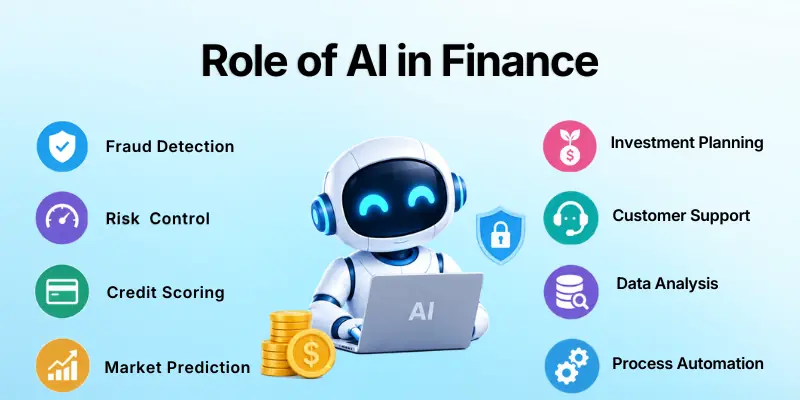
Here are the role of ai in financial services:
- Fraud Detection
- Risk Control
- Credit Scoring
- Market Prediction
- Investment Planning
- Customer Support
- Data Analysis
- Process Automation
- Loan Approval
- Expense Tracking
- Trading Decisions
- Portfolio Management
- Compliance Check
- Cost Reduction
- Performance Tracking
Let’s go over all of these in detail.
1. Fraud Detection
When I think of fraud detection, I picture how smart systems watch every transaction to keep our money safe. It checks thousands of records in seconds to find anything unusual. I find it interesting how it can spot fake actions before people even notice. It studies past fraud cases to learn what looks suspicious. This way, it protects both banks and customers from loss. I trust this role the most because it builds safety into every transaction.
Benefits:
- Finds fake or risky activity fast
- Keeps customer accounts safe
- Reduces fraud losses
Example: AI systems in PayPal scan millions of transactions daily to block suspicious activities instantly.
2. Risk Control
Risk control is all about keeping money decisions safe and steady. I see it as AI’s way of helping people avoid mistakes in finance. It studies past data to warn when something looks risky. It can tell if a loan, trade, or investment might go wrong. I like how it gives confidence to financial planners and business owners. It helps me think ahead and plan with fewer surprises.
Benefits:
- Spots risks early
- Helps make safe choices
- Reduces losses in business
Example: Banks use AI systems to review a client’s history and flag high risk loan applicants.
3. Credit Scoring
Credit scoring is one of my favorite parts of AI in finance. It judges how likely someone is to repay borrowed money. It looks at data like income, spending, and payment habits. I find it fair because it removes personal bias and uses only facts. It also helps people who don’t have a long credit history. It makes lending faster, clearer, and more reliable.
Benefits:
- Makes credit decisions fast
- Ensures fair evaluation
- Helps more people get loans
Example: Upstart uses AI to check creditworthiness beyond old school credit scores.
4. Market Prediction
Market prediction means using data to guess what will happen next in the market. I like how it studies stock prices, trends, and even global news. It helps traders make smart choices without just guessing. I think this role is powerful because it gives clarity in a fast changing world. It allows me to make informed investment decisions. With AI, predictions are faster and often more accurate than human forecasts.
Benefits:
- Helps plan better investments
- Reduces market risks
- Improves profit chances
Example: AI trading systems forecast stock price changes using real time market data.
5. Investment Planning
Investment planning is like getting smart guidance for your money. AI studies your goals, income, and risk level to suggest the best plans. I find it helpful because it removes confusion about where to invest. It feels like having a digital financial advisor that knows you well. It saves time and helps you stay on track with your financial dreams. With AI, you can plan investments confidently and easily.
Benefits:
- Gives tailored investment ideas
- Saves planning time
- Improves financial growth
Example: Betterment uses AI to create custom portfolios for each investor.
6. Customer Support
Customer support powered by AI gives instant help anytime, day or night. I like how it answers questions without waiting for a human agent. It can guide users, solve small problems, and give quick updates. This makes service smoother and faster. I’ve noticed it also keeps customers happier and more engaged. For me, it feels like a friendly helper is always ready to assist.
Benefits:
- 24/7 instant help
- Reduces waiting time
- Improves customer experience
Example: Banks use chatbots like Erica from Bank of America to help customers check balances or pay bills.
7. Data Analysis
Data analysis is one of the strongest roles AI plays in finance. It looks through massive amounts of numbers and reports in seconds. I find it exciting because it turns raw data into clear insights. It helps financial teams spot patterns and make smart decisions. I think it saves hours of manual work while improving accuracy. It’s like having a data expert that never gets tired.
Benefits:
- Finds useful insights quickly
- Improves decision quality
- Saves time on analysis
Example: AI tools in accounting firms analyze spending data to plan budgets more effectively.
8. Process Automation
Process automation makes everyday tasks simple and smooth. It takes over routine work like form checking or report generation. I’ve seen how it frees up people to focus on more important things. It also reduces human mistakes and speeds up results. For me, it’s one of the biggest time savers in finance. It keeps things moving without constant supervision.
Benefits:
- Saves time and effort
- Reduces human error
- Boosts productivity
Example: Banks use automation tools to handle customer data updates and billing reports.
9. Loan Approval
Loan approval becomes faster and smarter with AI. It studies your income, spending, and repayment history in seconds. I like how it makes the process fair by relying on data, not guesses. It gives quick results, so people don’t have to wait days for an answer. It also lowers the risk of wrong approvals. I think it’s one of the best ways AI improves customer trust in finance.
Benefits:
- Faster loan decisions
- Fair evaluation
- Less manual work
Example: Fintech apps use AI to approve small personal loans within minutes.
10. Expense Tracking
Expense tracking helps you see where your money goes. I find it useful because it automatically tracks spending and sorts it into categories. It reminds you when you overspend and helps set saving goals. For me, it builds better money habits over time. It feels like a personal money coach that watches quietly but helps wisely. It’s simple, accurate, and stress free.
Benefits:
- Tracks expenses easily
- Builds saving habits
- Improves budgeting
Example: Mint uses AI to group spending into categories and give saving suggestions.
11. Trading Decisions
AI supports trading by giving smart buy and sell advice. It reads market data, trends, and news to make quick calls. I like how it removes emotional trading and focuses on facts. It reacts in seconds when markets change. For traders like me, it feels like having a data driven partner who never misses a signal. It keeps trades fast, smart, and consistent.
Benefits:
- Quicker trading actions
- Reduces emotional bias
- Increases profit chances
Example: AI-based bots help traders decide when to buy or sell based on data trends.
12. Portfolio Management
Portfolio management means balancing your investments wisely. AI checks your stocks, funds, and savings to find the right mix. I like how it adjusts automatically as markets move. It keeps your risk level under control and maximizes growth. I see it as a digital manager that monitors your money 24/7. It makes investing simpler for everyone, even beginners.
Benefits:
- Keeps portfolio balanced
- Adapts to market changes
- Boosts long term returns
Example: Wealthfront uses AI to manage and rebalance user portfolios automatically.
13. Compliance Check
Compliance check keeps financial work in line with laws and policies. It’s one of those silent but vital roles I value most. AI monitors every transaction to find anything against rules. It helps companies stay transparent and avoid legal trouble. I think it builds trust and protects both sides, business and customer. It’s a must have in today’s finance world.
Benefits:
- Ensures rule compliance
- Avoids penalties
- Builds customer trust
Example: Banks use AI systems to spot suspicious payments under AML (Anti Money Laundering) laws.
14. Cost Reduction
Cost reduction is one area where AI saves the most. It cuts down manual work, speeds up jobs, and improves accuracy. I’ve noticed companies save big when they use AI tools. It helps reduce staff overload while keeping quality high. For me, it’s about working smarter, not harder. Every saved minute and dollar adds up to growth.
Benefits:
- Lowers business costs
- Improves productivity
- Reduces waste
Example: Insurance firms use AI chatbots to handle customer claims and save support costs.
15. Performance Tracking
Performance tracking checks how well financial systems or plans are doing. I like how AI reviews reports and finds what’s working or failing. It gives real time updates that help improve results. I see it as a mirror showing the true financial picture. It supports quick decisions and helps plan better next time. It keeps progress clear and goals achievable.
Benefits:
- Tracks results accurately
- Finds improvement areas
- Supports smarter planning
Example: Banks use AI dashboards to track branch performance and customer growth in real time.
Benefits of AI in Finance Industry
Artificial intelligence in finance helps make financial services faster, smarter, and more reliable. From fraud detection to better money management, AI offers several advantages for banks, businesses, and everyday customers.
Here are the overall summarized advantages of artificial intelligence in finance:
- Speeds up financial tasks and improves overall efficiency.
- Reduces human errors and increases work accuracy greatly.
- Detects fraud early and protects customer financial accounts.
- Improves decision making using accurate and real time data.
- Provides personalized money advice based on user goals.
- Automates routine financial jobs to save more time.
- Cuts business costs while improving long term performance.
- Enhances customer support with quick and smart responses.
- Predicts market trends to guide better investment choices.
- Protects financial systems from online threats and hacking.
- Ensures full rule compliance across financial organizations.
- Builds stronger trust between banks and their customers.
- Tracks company performance for smarter financial planning.
- Makes credit approval faster, fairer, and more transparent.
- Supports better saving, spending, and financial management.
Artificial intelligence in finance helps banks, businesses, and customers manage money more easily and safely. These AI-powered financial tools improve daily tasks, support smarter decisions, and make financial services faster and more reliable. They also help organizations reduce costs, manage risks, and deliver better customer experiences.
Challenges of AI in Banking & Finance
AI in finance offers many benefits, but it also comes with challenges that banks and businesses must understand. The following points explain the common risks of using artificial intelligence in financial services.
- AI tools are expensive and hard to set up properly.
- Keeping customer financial data safe is always a challenge.
- Few trained people know how to manage AI systems.
- AI sometimes makes unfair or biased money decisions.
- It’s hard to explain how AI makes its choices.
- AI needs clean and correct data to give good results.
- Online hackers often try to break into AI systems.
- AI systems need regular checks, fixes, and software updates.
- Many old banking systems do not work with AI.
- Some people fear AI may replace their jobs soon.
- AI can make mistakes when data is wrong or missing.
- Government rules for AI use are still not very clear.
- It’s tough to understand why AI made a decision.
- Sharing financial data between systems can be risky sometimes.
- Relying too much on AI can reduce human judgment.
These challenges show why AI in finance needs strong data security, clear rules, regular checks, and human supervision. Managing these risks can help banks and businesses use AI more safely and responsibly.
Future of AI in Financial Sector
I believe the future of AI in finance looks bright and full of change. In the coming years, AI will make banking faster, safer, and more personal for everyone. It will help people plan their money better and make smarter financial choices.
Banks will use AI to predict risks, spot fraud before it happens, and approve loans more quickly. Customer service will also become smoother as chatbots handle most of the basic support tasks.
I think personal finance apps will get smarter too, giving better tips for saving and spending. With stronger AI systems, financial data will stay safer from online threats. Overall, the future of AI in finance will bring more accuracy, trust, and comfort to how we manage and understand money.
Final Note
In this guide, I have covered the role of AI in finance in clear and simple detail. We explored how artificial intelligence is changing the finance world by making work faster, safer, and smarter. I talked about the main roles of AI, like fraud detection, risk control, trading, and customer support.
We also looked at the benefits it brings, the challenges it faces, and what the future of AI in finance looks like. My goal was to help you understand how AI is shaping modern banking, investing, and money management in real life.
If you still have questions or want to learn more, take a look at the FAQs below; they will clear up many common doubts about the role of AI in finance.
FAQs About AI in Finance Affairs
These FAQs explain how AI in finance works, its main uses, and its benefits for banks, businesses, and customers. Find quick answers to common questions about artificial intelligence and financial services.
1. What Is AI for Finance?
AI for finance means using smart computer tools to manage money related tasks. It helps banks and businesses save time, study data, and make better decisions.
2. How Does AI and Finance Work Together?
AI helps financial services by studying data, finding risks, and predicting possible changes. It supports faster decisions and better customer service.
3. What Is Artificial Intelligence in Finance Used For?
Common uses of artificial intelligence in finance include:
- Detecting fraud and unusual payments
- Checking loan applications and credit scores
- Supporting customers through chatbots
- Studying market trends
4. How Does Finance AI Help Banks and Businesses?
Finance AI helps banks and businesses automate daily tasks, reduce errors, and manage risks. It also supports budgeting, fraud detection, and customer service.
5. What Are the Main AI Applications in Finance?
| AI Application | Main Purpose |
|---|---|
| Fraud detection | Finds suspicious transactions |
| Credit scoring | Helps assess loan risks |
| Trading | Studies market data |
| Chatbots | Answers customer questions |
| Risk management | Helps identify financial risks |
6. How Do AI Financial Services Improve Customer Experience?
AI financial services can make banking easier through:
- Faster support: Chatbots answer common questions.
- Personalized help: Tools offer relevant financial guidance.
- Quick service: Automated systems handle routine requests.
7. What Are the Benefits of AI in Finance?
The main benefits include faster work, better data analysis, lower operating costs, and improved fraud detection. AI can also help financial teams make informed decisions.
8. What Are Common AI Use Cases in Finance?
Here are three common ways AI is used in finance:
- Detecting fraud: Find unusual account activity.
- Track spending: Organize expenses and identify patterns.
- Predict trends: Study data to support financial planning.
9. What Are the Key Applications of AI in Finance?
The key applications include fraud detection, risk assessment, automated trading, credit scoring, and regulatory compliance. These tools help financial organizations review information and manage tasks more efficiently.
10. How Are Machine Learning and Finance Connected Today?
Machine learning helps financial systems learn from past data and identify patterns. The process often works in three steps:
- Collect financial data.
- Train a model to recognize patterns.
- Use its predictions to support decisions.






- Be Respectful
- Stay Relevant
- Stay Positive
- True Feedback
- Encourage Discussion
- Avoid Spamming
- No Fake News
- Don't Copy-Paste
- No Personal Attacks
- Be Respectful
- Stay Relevant
- Stay Positive
- True Feedback
- Encourage Discussion
- Avoid Spamming
- No Fake News
- Don't Copy-Paste
- No Personal Attacks
